

Likelihood validation#
Scope#
This validation compares the Fisher forecasts produced by CosmicJellyfish with posterior samples from its Nautilus likelihood interface. It is intentionally a focused integration test rather than a claim that every likelihood, configuration, or cosmological model has been validated.
The recorded run uses the symbolic backend, flat LCDM, Euclid ISTF pessimistic
photometric and spectroscopic specifications, and the free cosmological
parameters Omegam and sigma8. All nuisance parameters automatically added
by the corresponding Fisher calculation were sampled: three intrinsic-alignment
parameters for WL and four galaxy-bias plus four shot-noise parameters for
GCsp. Thus the Nautilus posteriors and Fisher contours are both marginalised
over the same nuisance parameter sets.
The run used 64 Nautilus workers, n_live=500, and n_eff=2000. The tracked
summary statistics live in
scripts/likelihood_validation_results/wl_gcsp_symbolic_euclid_64cpu_statistics.json.
The raw chains and checkpoints are intentionally excluded from the repository.
Results#
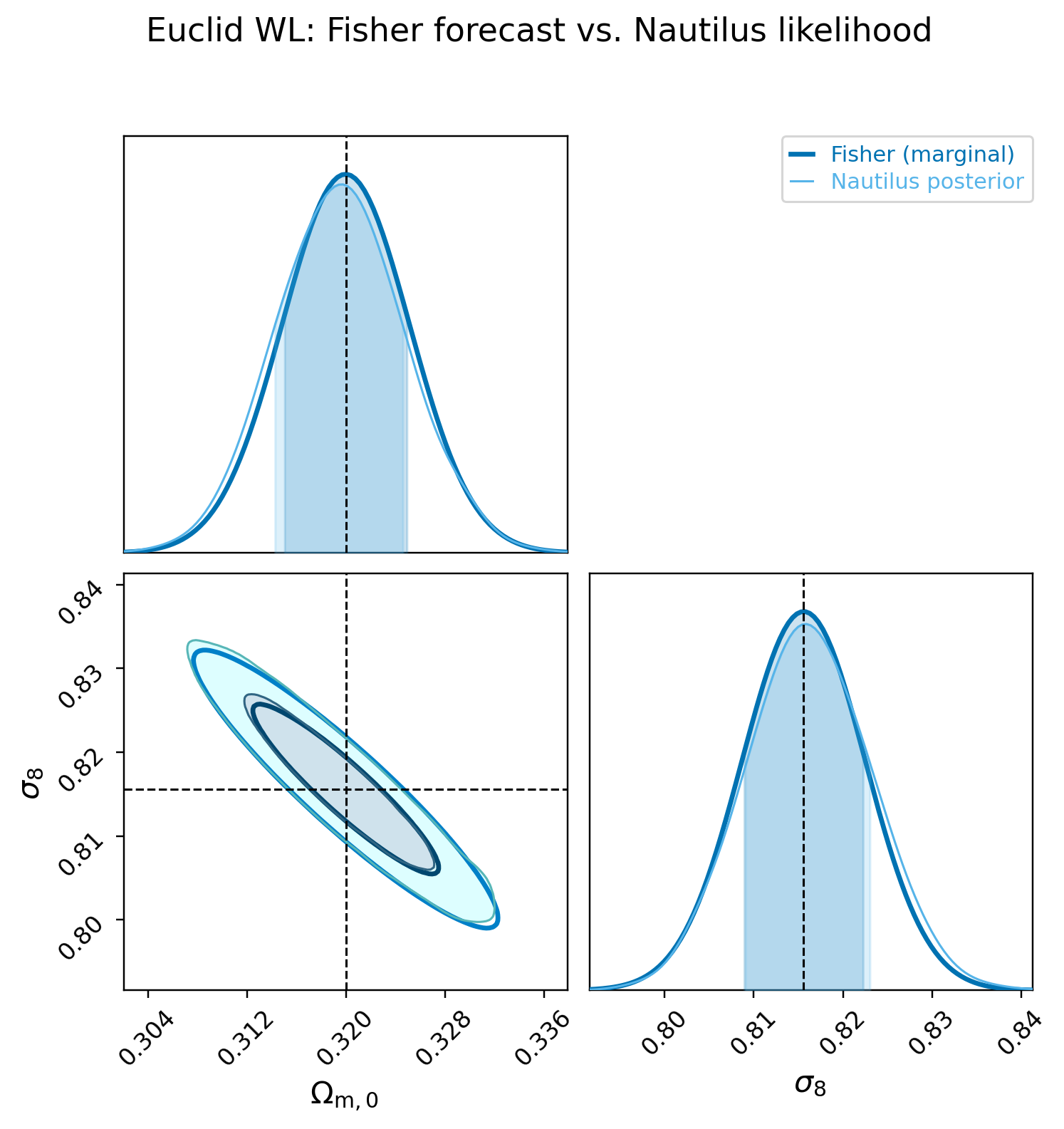
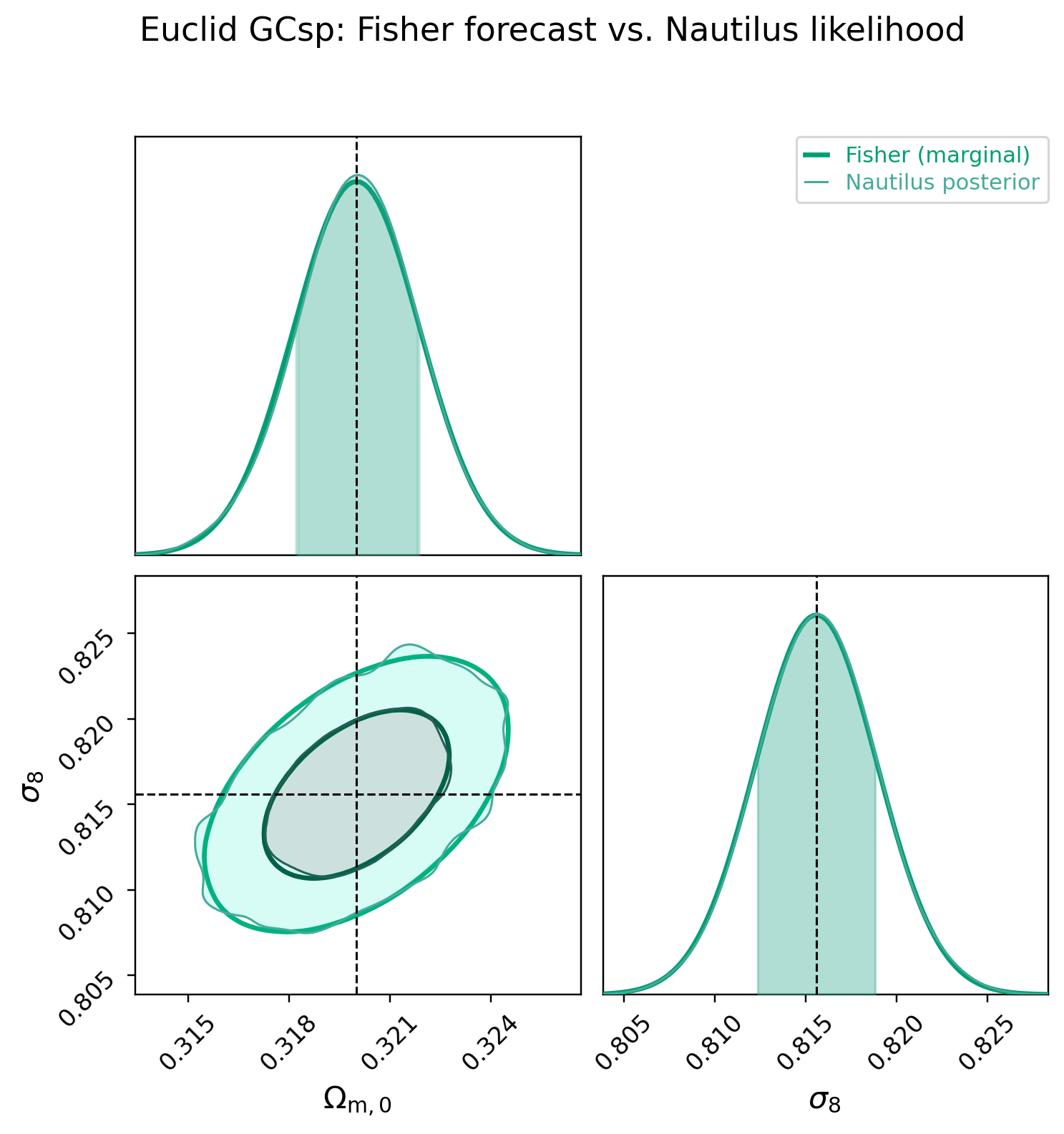
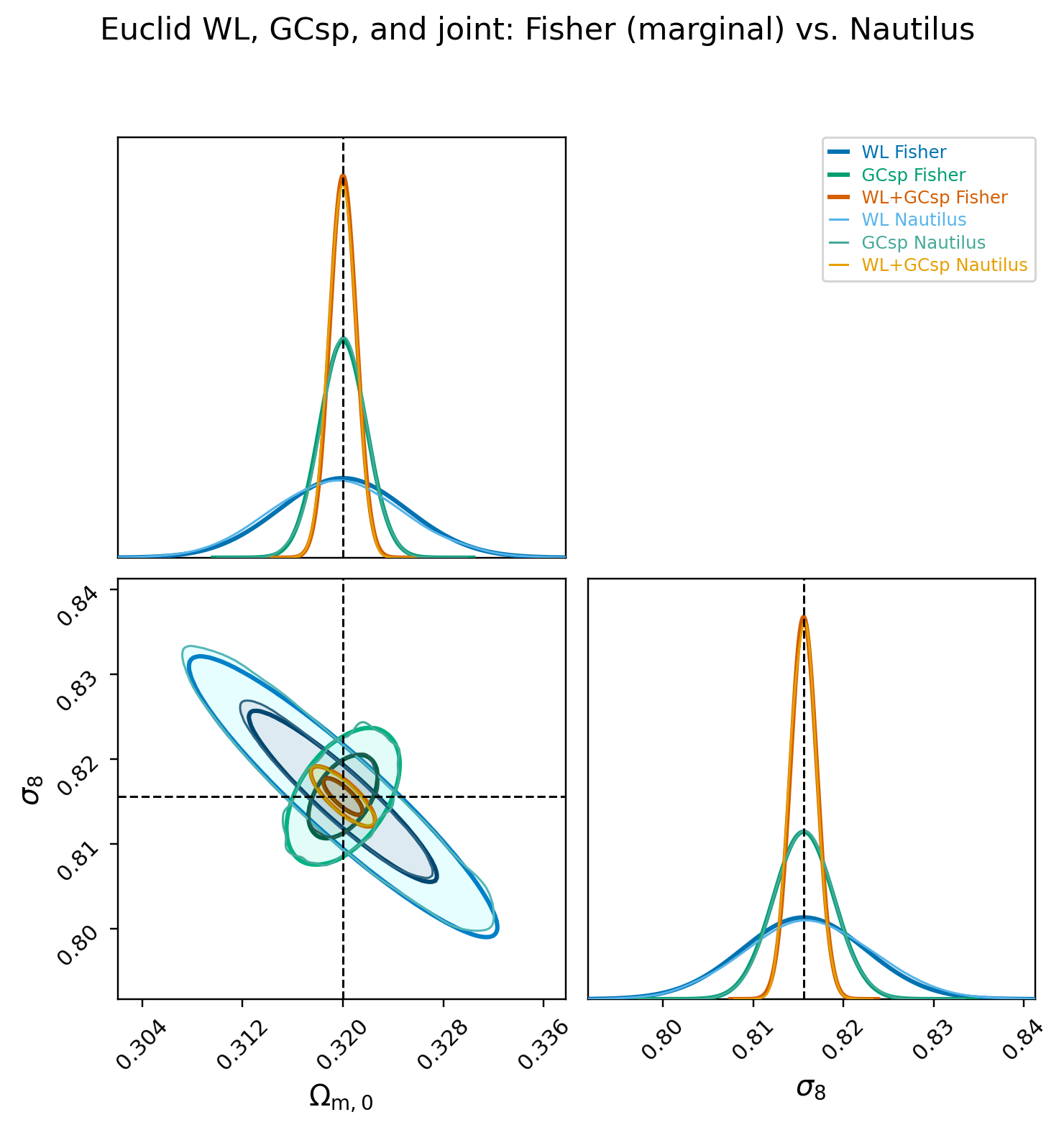
The figures were generated with CosmicJellyfish’s ChainConsumer integration from the weighted Nautilus chains. Each probe has a stable color pair: dark contours are marginal Fisher forecasts and lighter contours are Nautilus posterior samples. WL is blue, GCsp is green, and the joint result is orange. Dashed lines mark the fiducial cosmology.
Weak lensing#
Spectroscopic galaxy clustering#
Joint WL + GCsp#
This overview shows all six contours: the WL, GCsp, and joint Fisher-Nautilus pairs.
Probe |
Nautilus / Fisher: |
Nautilus / Fisher: |
Correlation: Nautilus / Fisher |
|---|---|---|---|
WL |
1.044 |
1.048 |
-0.9930 / -0.9932 |
GCsp |
1.004 |
1.003 |
+0.4961 / +0.5083 |
WL + GCsp |
1.013 |
1.005 |
-0.8546 / -0.8501 |
The posterior means are within 0.09 standard deviations of the fiducial for WL, 0.02 for GCsp, and 0.06 for the joint case. Within the sampling precision of the retained chains, this validates the tested WL, GCsp, and joint wedge likelihood implementations against their corresponding marginal Fisher forecasts.
Computational resources#
Each probe was submitted as an independent Slurm job with CPUS_PER_TASK=64.
The case runner passed all 64 allocated CPUs to Nautilus as multiprocessing
workers and pinned OpenMP, BLAS, and NumExpr thread counts to one, avoiding
oversubscription inside each worker.
Case |
Sampled dimensions |
Nautilus workers |
|
Target |
Recorded elapsed time |
Chain ESS |
|---|---|---|---|---|---|---|
WL |
5 |
64 |
500 |
2000 |
17 min 03 s |
2101 |
GCsp |
10 |
64 |
500 |
2000 |
22 min 29 s |
2764 |
WL + GCsp |
13 |
64 |
500 |
2000 |
1 h 45 min 05 s |
2057 |
Elapsed times include Fisher setup and Nautilus sampling; the latter dominates each case. The three jobs ran concurrently, so their times must not be summed as sequential wall time. The joint case sets the approximately 1 h 45 min validation makespan.
The metadata does not identify the exact JURECA node class. Consult the JURECA DC hardware configuration and Slurm accounting records for node-specific hardware details.
Reproduction#
Run the three independent Slurm cases and their dependent post-processing job:
RUN_DIR=/scratch/$USER/cfp/wl-gcsp-64cpu \
N_LIVE=500 N_EFF=2000 CPUS_PER_TASK=64 \
scripts/hpc/slurm/submit_wl_gcsp_nautilus.sh
After copying a completed run locally, regenerate the tracked evidence without copying chains into the repository:
uv run python scripts/likelihood/postprocess/render_likelihood_validation.py \
  --run-dir hpc-results/wl-gcsp-64cpu